
Cabbie's London — South Bank
South Bank Walking Route
London Eye → South Bank → Tate Modern → Borough Market → London Bridge


Walk Map
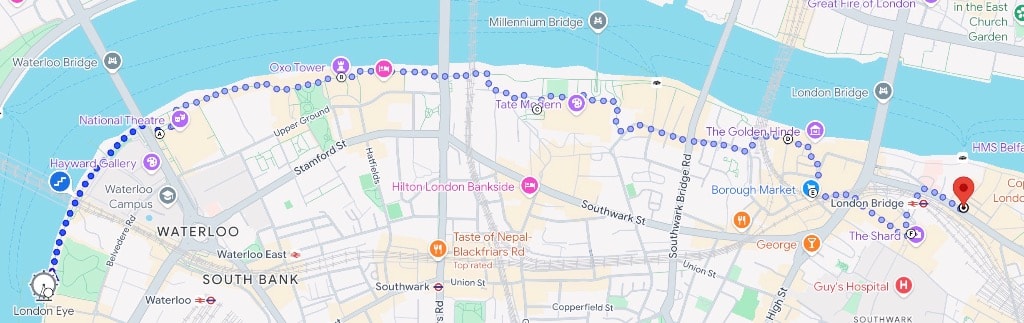
The Route
Stop by Stop
London Eye
Start here — Jubilee Gardens, South Bank
Begin at the London Eye. Tickets are required if you want to ride — it's worth booking ahead as queues can be long. Nearby you'll also find other paid experiences including Shrek's Adventure and Sea Life. The area is busy and the food and drink prices reflect that — walk further along the river for better value.
A Temporary Landmark
Opened in 2000 as part of the Millennium celebrations, the London Eye was originally intended to be a temporary structure. It was only meant to stand for five years. It became so popular it was made permanent and is now one of London's most visited attractions, carrying around 3.5 million passengers a year. At 443 feet it was the world's tallest observation wheel when it opened.
South Bank Riverside Walk
East along the Thames from the Eye
Walk east along the river. This is one of the liveliest pedestrian stretches in London — street performers, second-hand book stalls under Waterloo Bridge, and constant views across the Thames to the Embankment. It's free, it's flat, and it's one of the best walks in the city.
The Book Market Under the Bridge
The second-hand book stalls beneath Waterloo Bridge have been trading since the 1980s. They're run by independent sellers and are one of the few remaining outdoor book markets in London. The location is protected from rain by the bridge above, which is why they've survived while similar markets elsewhere have disappeared. Worth a browse even if you don't buy.
Royal Festival Hall, Hayward Gallery & National Theatre
Belvedere Road — the cultural quarter
Continue past these cultural landmarks. The Royal Festival Hall was built for the 1951 Festival of Britain and is still one of the best concert venues in London. The Hayward Gallery runs major contemporary art exhibitions. The National Theatre puts on some of the best theatre in the country. The area often has free outdoor events — check what's on before you go.
The Festival of Britain
The Royal Festival Hall was the centrepiece of the 1951 Festival of Britain — a national morale-boosting event organised six years after the end of World War II. The rest of the festival site was demolished afterwards, but the Festival Hall survived and became the anchor for what is now one of the most concentrated cultural districts in Europe. It was Grade I listed in 1988.
OXO Tower
Upper Ground — between the National Theatre and Tate Modern
Further along you'll reach Gabriel's Wharf, a small cluster of independent shops and food stalls, and the OXO Tower. Good spot for photos and a slightly quieter feel than the main South Bank strip. The OXO Tower restaurant on the upper floors has excellent views — the brasserie is more affordable than the restaurant.
Advertising in Disguise
The OXO Tower was originally a power station, later converted into a cold storage facility for the Liebig Extract of Meat Company — makers of OXO stock cubes. When they applied to put illuminated advertising on the tower, the London County Council refused. So they designed the windows in the shape of the letters O, X, O — technically architectural features, not advertising. The council couldn't object. The building dates from 1928.
Tate Modern
Bankside — the old power station
Head to Tate Modern. Free to enter for the permanent collection. Even a quick walk through the Turbine Hall is worth it — the space is extraordinary and often hosts large-scale commissioned installations. The building itself, a converted power station, is as impressive as anything inside it. Allow at least an hour if you want to see the galleries properly.
Power Station to Art Gallery
Opened in 2000 inside the former Bankside Power Station, which was designed by Sir Giles Gilbert Scott — the same architect who designed the red telephone box and Battersea Power Station. The building closed as a power station in 1981 and sat derelict for nearly two decades. Tate Modern quickly became one of the most visited modern art galleries in the world, attracting around 6 million visitors a year.
Borough Market
8 Southwark Street — under the railway arches
Continue east to Borough Market. Excellent variety of street food and produce — one of the best places on the route to stop and eat. Best visited Wednesday to Saturday when the full market is open. Busy on weekends but worth it. Try to arrive before 1pm to avoid the worst of the lunchtime crowds.
A Thousand Years of Trading
One of London's oldest food markets, with roots going back over a thousand years. A market has existed on or near this site since at least the 11th century. The current covered market structure dates from the 1850s. It was nearly demolished in the 1990s to make way for a road scheme but was saved by a campaign from local traders and residents. It has since become one of the most celebrated food markets in Europe.
London Bridge, The Shard & Hay's Galleria
London Bridge Street — end of the route
You'll now be near London Bridge station, The Shard, and Hay's Galleria — a Victorian wharf converted into a covered shopping arcade with a large kinetic sculpture inside. This is a good point to finish the walk. If you still have energy, Tower Bridge is around 15 minutes further east along the river.
The Tallest Building in the UK
The Shard was completed in 2012 and designed by Italian architect Renzo Piano. At 1,016 feet it is the tallest building in the UK and Western Europe. It contains offices, restaurants, a hotel and a public viewing gallery. The design was inspired by the spires of London's churches and the masts of sailing ships that once crowded the Thames. Planning permission was controversial — the Prince of Wales called it 'a shard of glass through the heart of historic London'.
Quick Cabbie Tips
- The London Eye area is very busy and full of tourist-trap food and drink prices. Walk a bit further along the river or wait until Borough Market for better value.
- Borough Market is best Wednesday to Saturday — some stalls are closed on Monday and Tuesday.
- Most of this route is free — you only pay if you choose the Eye, Shrek's Adventure, Sea Life, The Shard, or certain gallery exhibitions.
- The walk is flat and easy — suitable for all fitness levels and good for pushchairs.
- The second-hand book stalls under Waterloo Bridge are worth a browse — they've been there since the 1980s.
- Tate Modern's Turbine Hall is free and always worth a look — a large-scale commission is usually installed there.
Nine more routes
The Full London Collection
East London, Westminster, City of London, Kensington, Greenwich, Camden and more. One payment. All guides. More added over time.
Cabbie's London · Real recommendations from the driver's seat · Enjoy the walk