
Cabbie's London — Notting Hill
Notting Hill Walking Route
Portobello Road → Westbourne Grove → Holland Park → Design Museum


Walk Map
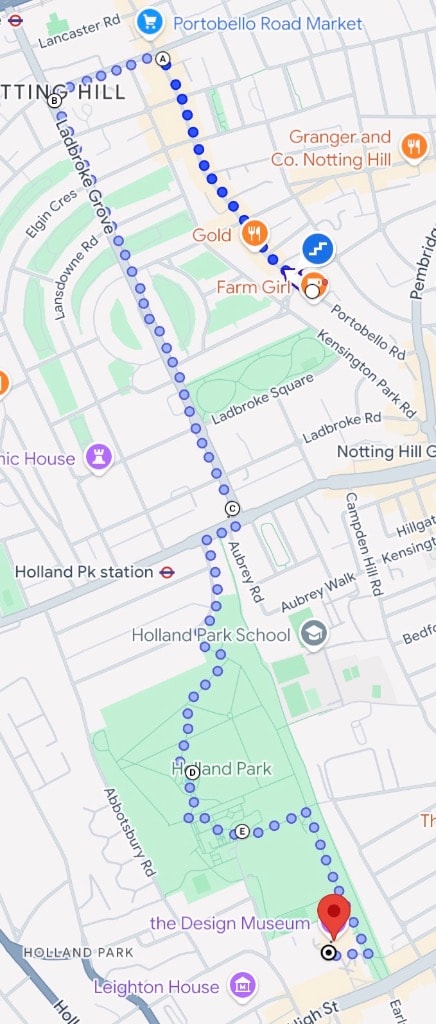
The Route
Stop by Stop
Portobello Road
Start here — Notting Hill Gate end, W11
Begin on Portobello Road and walk through the antiques market. Browse the independent stores, coffee shops and pubs as you go. The market stretches for about a mile and changes character as you walk north — antiques at the southern end, fruit and veg in the middle, and vintage clothing and street food further up. You can continue all the way to the end of the market if you wish.
One of the World's Great Street Markets
Portobello Road has been a market street since the 1860s, when it was known for herbs and spices. The antiques trade grew significantly after the Second World War, when dealers moved here from the Caledonian Market in Islington. Today it is one of the most famous street markets in the world. The antiques section — concentrated at the southern end near Notting Hill Gate — is particularly well known and has been popular with visitors for decades. The market runs every day but Saturday is the main event, when around 1,000 stalls trade.
Westbourne Park Road
Westbourne Park Road / Lancaster Road area, W11
A good point to divert is at Westbourne Park Road, where you'll find some of the well-known pastel-coloured townhouses that Notting Hill is famous for. The streets around here — particularly Lancaster Road and the surrounding terraces — are the classic photo spots. The colours are best in morning light.
The Painted Terraces
The pastel-painted stucco terraces of Notting Hill were not always considered desirable. In the 1950s and 1960s, the area was one of the most deprived in London, with large houses subdivided into overcrowded bedsits. The transformation into one of the most expensive postcodes in the world happened gradually from the 1970s onwards as the houses were bought and renovated. The distinctive painted facades — cream, white, pale blue, pink and yellow — became the visual shorthand for a certain kind of wealthy West London living. The 1999 film Notting Hill, starring Hugh Grant and Julia Roberts, cemented the image internationally.
Ladbroke Grove
Ladbroke Grove, W10 / W11
Head towards Ladbroke Grove. This area has real Notting Hill character and was the heart of London's first major Caribbean community. The streets around here are where the Notting Hill Carnival takes place every August Bank Holiday — the largest street festival in Europe.
The Heart of the Carnival
From the 1950s onwards, Notting Hill became home to one of Britain's first large Caribbean communities, as people arrived from Trinidad, Barbados, Jamaica and other islands under the British Nationality Act. The community faced significant hostility — the Notting Hill race riots of 1958 were among the worst in British history. The Carnival was founded in 1966 by Trinidadian activist Claudia Jones as a direct response, intended to celebrate Caribbean culture and build community solidarity. It now attracts around two million people over the August Bank Holiday weekend and is the largest street festival in Europe.
Holland Park
Holland Park, W8 — Ilchester Place entrance
Continue into Holland Park. A beautiful, slightly hidden park with formal gardens, woodland and open space. It is noticeably quieter than Hyde Park or Kensington Gardens and has a different character — more enclosed, more varied in landscape. The Japanese Kyoto Garden inside the park is particularly worth finding.
A Hidden Park
Holland Park covers 54 acres and was the private grounds of Holland House until the estate was sold to the London County Council in 1952. The park opened to the public in 1952. It is divided into several distinct areas — formal gardens near the house, a woodland area with peacocks, and open sports grounds. The Kyoto Garden, a traditional Japanese garden donated by the city of Kyoto in 1991 to mark the Japan Festival in London, is one of the most peaceful spots in West London. The open-air theatre in the park runs a summer opera season every year.
Holland House & Orangery
Inside Holland Park, W8
Inside the park, visit the remains of Holland House and the Orangery. The house was one of the grandest Jacobean mansions in London before it was almost completely destroyed in the Blitz. What remains — the east wing and the arcaded loggia — is now used as a youth hostel. The Orangery alongside it hosts art exhibitions and events.
Bombed but Not Forgotten
Holland House was built in 1605 for Sir Walter Cope and became one of the great Whig political and literary salons of the 18th and 19th centuries. Lord and Lady Holland entertained Byron, Dickens, Macaulay and Talleyrand here. On the night of 27 September 1940, German incendiary bombs destroyed most of the house in a single night. Photographs taken the morning after — showing the ruined shell with books still on the shelves — became some of the most famous images of the Blitz. The east wing survived and was converted into a youth hostel in 1959, which it remains today.
Design Museum
224–238 Kensington High Street, W8
Walk down to the bottom of Holland Park and finish at the Design Museum on Kensington High Street. The permanent collection is free. The building itself — a converted Commonwealth Institute from the 1960s — is worth seeing, with its distinctive hyperbolic paraboloid roof. A good end point to the walk.
Design as a Discipline
The Design Museum was founded in 1989 by Sir Terence Conran and Stephen Bayley, originally in a converted banana warehouse at Shad Thames near Tower Bridge. It moved to its current home — the former Commonwealth Institute building on Kensington High Street — in 2016. The Commonwealth Institute was built in 1962 to celebrate the newly independent nations of the British Commonwealth and was notable for its striking tent-like copper roof. The conversion preserved the roof and the dramatic interior volume while creating a modern museum inside. The permanent collection covers contemporary design, architecture and fashion and is free to visit.
Quick Cabbie Tips
- Portobello Road Market is busiest on Saturdays — great atmosphere but also the most crowded day. Arrive before 10am if you want to browse without the crowds.
- The pastel houses around Westbourne Park Road and Lancaster Road are the classic photo spots. Morning light is best.
- Holland Park is often quieter than the bigger central parks and makes a nice contrast after the market. Find the Kyoto Garden — it's easy to miss but worth it.
- The Design Museum's permanent collection is free to enter.
- If you're here on August Bank Holiday weekend, the Notting Hill Carnival takes over the whole area. Extraordinary atmosphere — but plan ahead, as transport gets very busy.
- The open-air opera at Holland Park runs through the summer. Worth checking the programme if you're visiting between June and August.
Nine more routes
The Full London Collection
East London, Westminster, City of London, South Bank, Kensington, Greenwich, Camden and more. One payment. All guides. More added over time.
Cabbie's London · Real recommendations from the driver's seat · Enjoy the walk