
Cabbie's London — City of London
City of London Walking Route
Stock Exchange → St Paul's → Mithraeum → Monument → Bank


Walk Map
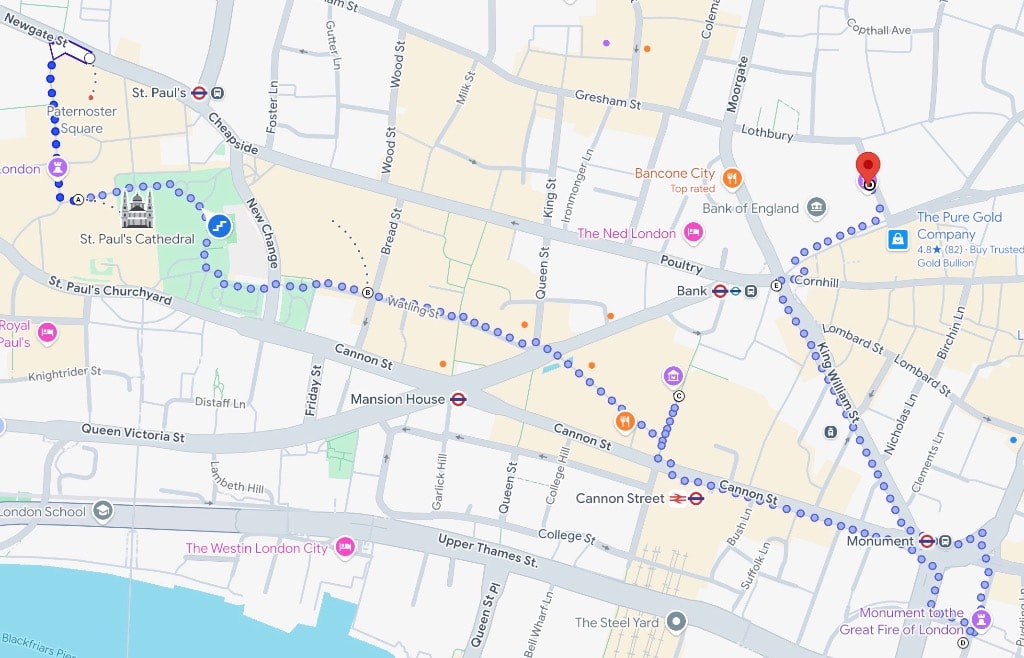
The Route
Stop by Stop
London Stock Exchange
Start here — Newgate Street
Begin outside the modern Stock Exchange building. This area has been the centre of London's financial world for centuries. The current building dates from 2004, but trading on this site goes back to the 17th century.
Centuries of Commerce
The London Stock Exchange traces its origins to the coffee houses of Exchange Alley in the 1690s, where merchants and brokers would meet to trade shares. It was formally established in 1801. Today it is one of the largest stock exchanges in the world by market capitalisation.
St Paul's Cathedral
Paternoster Square → St Paul's Churchyard
Walk through Paternoster Square into the open space in front of St Paul's. One of London's greatest buildings and a must-see, even if you only view it from outside. The dome dominates the skyline and the steps are a natural gathering point.
Wren's Masterpiece
Designed by Sir Christopher Wren and completed in 1710 after the Great Fire destroyed the medieval cathedral. It survived the Blitz in World War II and became a symbol of London's resilience. The dome is 365 feet high — one foot for every day of the year. The Whispering Gallery inside the dome is famous for its acoustic properties: a whisper against the wall can be heard clearly on the opposite side.
One New Change
Just behind St Paul's
A modern shopping centre with a free rooftop terrace that gives excellent views of the cathedral from behind and above. Worth a quick detour — it's one of the best free viewpoints in the City and most visitors walk straight past it.
The Secret Rooftop
Designed by French architect Jean Nouvel and opened in 2010. The rooftop terrace is free to access and gives a perspective on St Paul's that most tourists never see — looking down on the dome from the east. The building's angular glass facade was designed to reflect the cathedral without competing with it.
London Mithraeum
Walbrook — Bloomberg Space
Head down towards Walbrook. Visit the London Mithraeum (Bloomberg Space) — a well-preserved Roman temple to the god Mithras, discovered during building works and now displayed underground. Entry is free but timed bookings are often required.
Roman London Underground
The temple dates from around 240 AD and was discovered in 1954 during post-war rebuilding work. It caused a sensation at the time — thousands of Londoners queued to see it. The temple was carefully moved and later reconstructed in its original location when Bloomberg built their European headquarters above it. The underground display uses light and sound to recreate the atmosphere of a Roman ritual.
The Monument
Monument Street — junction with Fish Street Hill
Continue along Cannon Street to The Monument. This tall stone column was built to commemorate the Great Fire of London in 1666. You can climb it for views if you wish — 311 steps to the top. The views over the City are excellent on a clear day.
A Measuring Stick in Stone
Completed in 1677 and designed by Christopher Wren and Robert Hooke. Its height — 202 feet — is said to mark the exact distance from the base to the bakery in Pudding Lane where the Great Fire started. If the column were tipped over to the west, its tip would land precisely on the spot where the fire began. Climbers receive a certificate at the top.
Bank Junction
King William Street — the heart of the City
Walk north up King William Street into Bank Junction — one of the busiest and most important junctions in the City. Six roads meet here, surrounded by some of the most significant financial buildings in the world.
The Crossroads of Capital
Bank Junction sits at the intersection of six streets and is surrounded by the Bank of England, the Royal Exchange, Mansion House (the Lord Mayor's official residence) and several major banks. It was pedestrianised during peak hours in 2018 after a series of cyclist fatalities. The junction has been a centre of commerce since the Romans built their forum nearby.
Royal Exchange
Threadneedle Street — facing the Bank of England
Stand in front of the Royal Exchange. The grand building has been a centre of commerce for hundreds of years and now houses luxury shops and restaurants. The courtyard inside is worth a look.
Three Exchanges, One Site
First opened in 1571 by Queen Elizabeth I as a centre for merchants to conduct business. The original building burned down in the Great Fire of 1666. The second was destroyed by fire in 1838. The current building is the third on the site and dates from the 1840s. The grasshopper weathervane on top is the symbol of the Gresham family, who founded the original exchange.
Bank of England
Threadneedle Street — the Old Lady herself
Look across at the Bank of England. If time allows, visit the Bank of England Museum (free entry) to see the history of British money and gold. The museum is inside the building and is surprisingly engaging — you can even lift a real gold bar.
The Old Lady of Threadneedle Street
Founded in 1694 to raise money for King William III's war against France. It has been known as 'the Old Lady of Threadneedle Street' for more than 200 years — the nickname comes from a 1797 political cartoon. The current building was designed by Sir John Soane and later rebuilt by Herbert Baker in the 1930s. The Bank holds around 400,000 gold bars in its vaults — the second largest gold reserve in the world.
Quick Cabbie Tips
- This is a compact route — ideal if you only have a morning or afternoon.
- The Mithraeum is free but often requires a timed booking — check the Bloomberg Space website before you go.
- The Monument climb is steep (311 steps) but gives excellent views of the City. You get a certificate at the top.
- The Bank of England Museum is free and well worth 30–45 minutes.
- Bank Junction can feel chaotic — take care crossing the roads, especially at peak times.
- The One New Change rooftop terrace is free and gives a brilliant view of St Paul's that most visitors miss.
Nine more routes
The Full London Collection
East London, Westminster, South Bank, Kensington, Greenwich, Camden and more. One payment. All guides. More added over time.
Cabbie's London · Real recommendations from the driver's seat · Enjoy the walk