
Cabbie's London — Central London
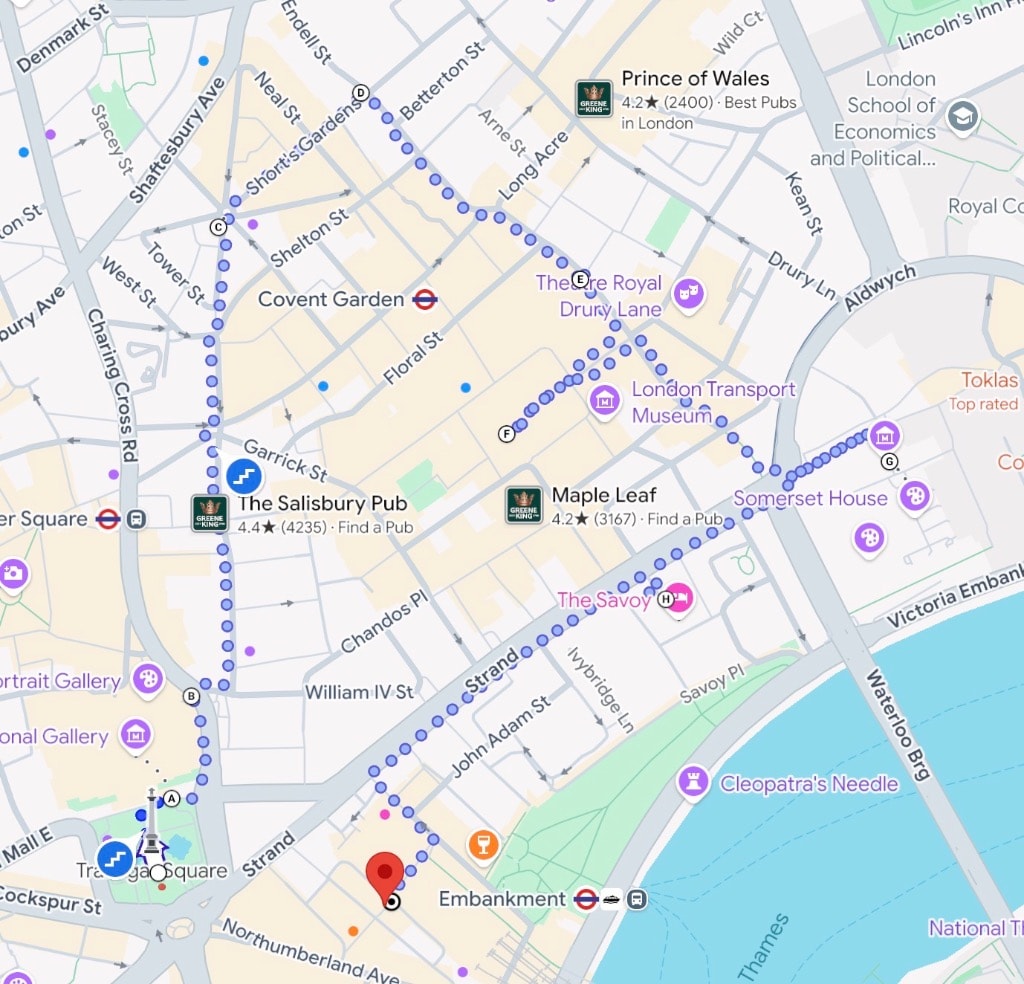
Central London Walking Route
Trafalgar Square → Seven Dials → Covent Garden → Strand → Villiers Street


The Route
Walk Map
The Route
Stop by Stop
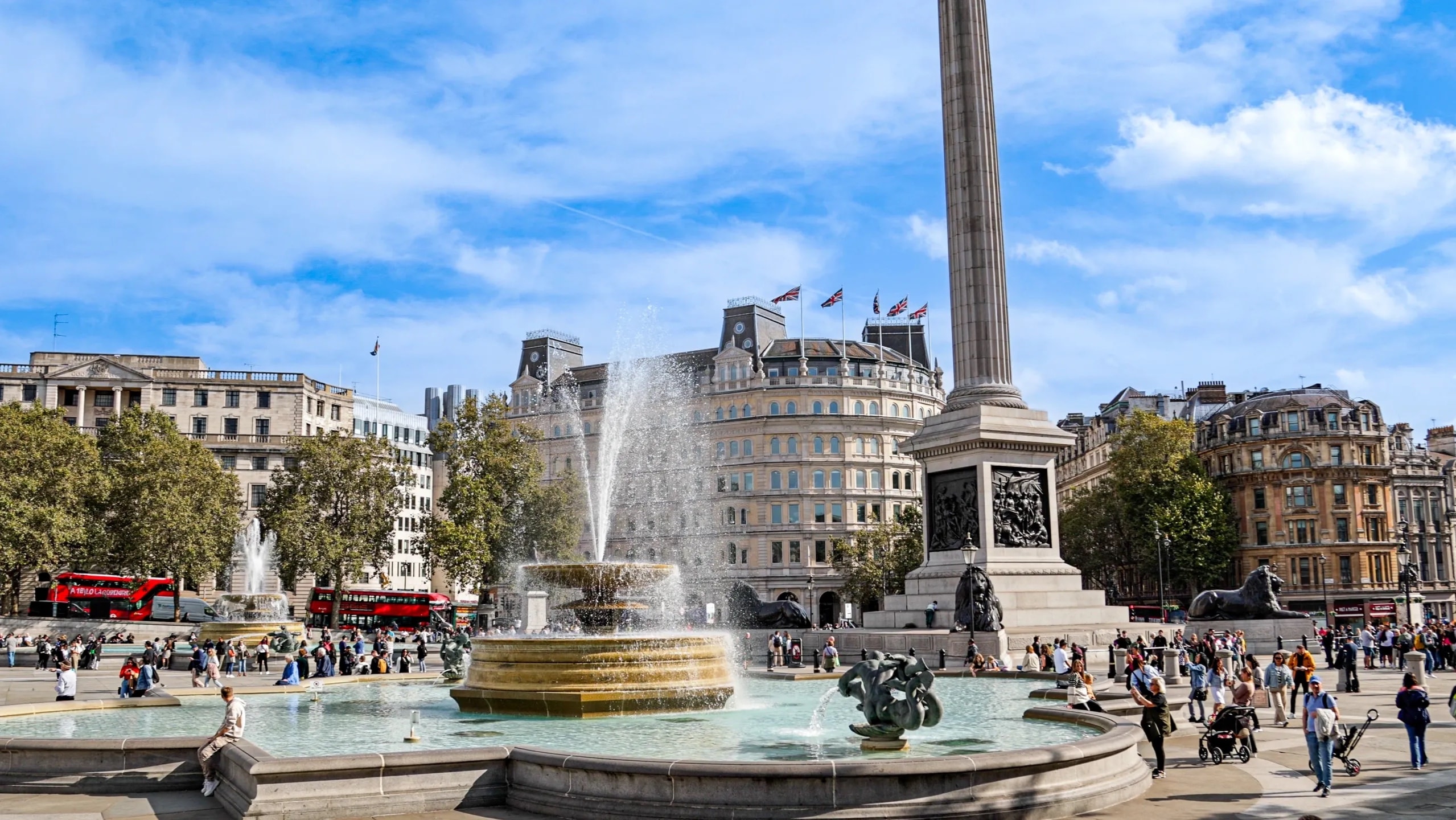
Trafalgar Square
Start here — in front of Nelson's Column
Stand in front of Nelson's Column. This is one of London's most famous public squares — lions at the base, fountains running, and the National Gallery looking over the whole thing. Good place to get your bearings before heading north.
Battle of Trafalgar, 1805
The square is named after the Battle of Trafalgar, where Admiral Nelson defeated the combined French and Spanish fleets but was fatally shot by a French sniper. Nelson's Column was completed in 1843. The four bronze lions at the base were added later in 1867, cast from cannon salvaged from Nelson's flagship, HMS Victory.
National Gallery
Top of Trafalgar Square
Walk up the steps into the National Gallery. Free entry. Even a quick look at a few famous paintings is worth it — Van Gogh's Sunflowers, Constable's The Hay Wain, Seurat's Bathers at Asnières. One of the great free things you can do in London.
Free Since 1824
The National Gallery was founded in 1824 when the government bought 38 paintings from a private collection. It now holds over 2,300 works covering 700 years of Western European painting. Entry has always been free to the public — a deliberate policy to make great art accessible to everyone, not just those who could afford it.
National Portrait Gallery
Around the corner on St Martin's Place
Just around the corner from the National Gallery. Also free. Good for a short wander if you like faces and history — the collection runs from Tudor monarchs to modern celebrities. Recently reopened after a major renovation.
The First of Its Kind
Founded in 1856, the National Portrait Gallery was the first portrait gallery in the world. The idea was that images of significant people were as important to national history as events. The earliest portrait in the collection is of Henry VII, painted in 1505.
Seven Dials
Head north up St Martin's Lane
Head north up St Martin's Lane into the Seven Dials area. Seven streets meet at a central column. Feels more local and less touristy than Covent Garden proper — independent shops, good coffee, and a bit more breathing room.
Designed for Maximum Rent
Seven Dials was designed in the 1690s by Thomas Neale, a property developer and Master of the Mint. The seven streets radiating from a central point were laid out deliberately to maximise the number of houses — and therefore rental income — on the available land. The sundial column in the centre is a replica; the original was removed in 1773 by a mob who believed treasure was buried beneath it.
Earlham Street Market
Earlham Street
Browse the market stalls on Earlham Street. Independent shops, street food and a good central London market feel without the full Covent Garden crowds. Worth a slow walk through.
The Seven Dials Neighbourhood
The streets around Seven Dials have changed character several times over the centuries — from a fashionable 17th-century development, to a notorious slum described by Dickens in Sketches by Boz, to the independent retail and food destination it is today. The transformation since the 1980s has been dramatic.
Rock & Sole Plaice
Endell Street
Continue down Endell Street. Stop at Rock & Sole Plaice if you fancy proper fish and chips — one of the better-known spots in the area and one of the oldest surviving fish and chip shops in London. Expect a short queue at peak times.
London's Oldest Chippy
Rock & Sole Plaice has been serving fish and chips on Endell Street since 1871, making it one of the oldest fish and chip shops in London. Fish and chips became a staple working-class meal in the 19th century — cheap, filling and available everywhere. George Orwell listed it among the things that kept the British working class content.
Royal Opera House
Bow Street
Walk south on Bow Street past the Royal Opera House. Impressive building even from the outside. The main façade on Bow Street is worth a look — the current building dates from 1858.
Bow Street Runners
Bow Street was also home to the Bow Street Magistrates' Court and the Bow Street Runners — widely considered Britain's first professional police force, established in 1749 by the novelist Henry Fielding. They operated from the court building on this street for nearly a century before the Metropolitan Police was founded in 1829.
Covent Garden Piazza
The main Piazza
Enter the main Piazza. Watch the buskers, soak up the atmosphere, and stop for a drink at the Punchbowl pub if you fancy one. The covered market building in the centre dates from 1830.
From Convent to Covent
The name Covent Garden is a corruption of 'convent garden' — it was originally the kitchen garden of Westminster Abbey. After the Dissolution of the Monasteries it passed to the Earl of Bedford, who developed it as a fashionable residential piazza in the 1630s. It became London's main fruit and vegetable market for centuries before the market moved to Nine Elms in 1974.
Theatre Royal Drury Lane
Catherine Street
Take a look at Theatre Royal Drury Lane — one of the oldest working theatres in London. The current building dates from 1812 but there has been a theatre on this site since 1663.
The Oldest Theatre Site in London
There has been a theatre on this site since 1663, making it the oldest working theatre site in London. The current building is the fourth on the site — its predecessors burned down twice. Famous performers who appeared here include David Garrick, Edmund Kean and Mrs Patrick Campbell. The ghost of a man in grey is said to haunt the upper circle.
Somerset House
The Strand
Continue south onto Catherine Street until you meet Aldwych and the Strand. Pause at Somerset House — beautiful courtyard and a good spot for photos. The building dates from the late 18th century and has been used as government offices, the Inland Revenue headquarters, and is now a major cultural centre.
Built Over the Thames
The current Somerset House was built between 1776 and 1801 on the site of a Tudor palace. Its south wing was built on arches over the Thames — the river originally came right up to the building before the Victoria Embankment was constructed in the 1860s. The spectacular courtyard has 55 fountains that emerge from the ground in summer and an ice rink in winter.
The Savoy
The Strand
Walk west along the Strand and glance at the Savoy Hotel on your right — one of London's most famous luxury hotels. The forecourt is the only road in Britain where traffic drives on the right.
Electric Lights and Right-Hand Traffic
The Savoy opened in 1889 and was the first hotel in Britain to have electric lights throughout, as well as the first with a significant number of en-suite bathrooms. The forecourt is famously the only road in Britain where traffic drives on the right — supposedly to make it easier for passengers to exit cabs directly onto the pavement.
Villiers Street → Ship & Shovel
Villiers Street, Embankment
Cut down John Adam Street into Villiers Street. This area has a lively, slightly hidden feel tucked between the Strand and the Embankment. Walk under the arches and finish with a drink at the Ship & Shovel — a good end-of-walk pub with a proper central London atmosphere.
The Ship & Shovel
The Ship & Shovel is one of London's more unusual pubs — it occupies two separate buildings on either side of a narrow alley, connected by a tunnel underneath. It's named after Admiral Cloudesley Shovell, a Royal Navy commander who was shipwrecked off the Scilly Isles in 1707. A good place to end a walk.
Quick Cabbie Tips
- This route mixes big tourist sights with better side streets — don't rush the Seven Dials section.
- Covent Garden gets very busy — go earlier in the morning if you prefer it quieter.
- Rock & Sole Plaice is popular, so expect a short wait at peak times.
- The National Gallery and National Portrait Gallery are both free — good value if you only have limited time.
- The Savoy forecourt is the only road in Britain where traffic drives on the right — worth a look as you pass.
Nine more routes
The Full London Collection
East London, Westminster, South Bank, Kensington, Greenwich, Camden and more. One payment. All guides. More added over time.
Cabbie's London · Real recommendations from the driver's seat · Enjoy the walk